

A Guide to Oil & Gas Storage Tanks
DESIGN TYPES, CONTAINMENT MECHANICS, AND PRODUCT APPLICATIONS
In the vast and complex infrastructure of the oil and gas industry, containment is just as critical as extraction and processing. From volatile liquefied gases to heavy crude oils, storing hydrocarbon products safely requires specialized engineering tailored to vapor pressure, chemical volatility, and environmental safety standards.
Atmospheric and Low-Pressure Storage
The backbone of surface storage facilities consists of tanks designed to hold liquids with low vapor pressures at or near ambient atmospheric pressure.
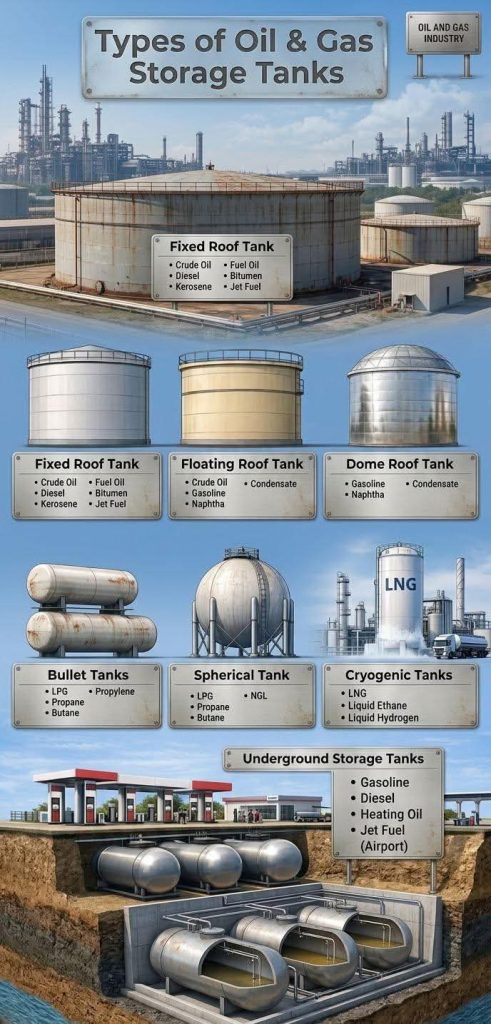
Fixed Roof Tanks
Characterized by a permanently affixed roof connected directly to the shell structure. These are robust and cost-effective, though vapor space above the liquid can accumulate flammable gases.
Types: Bitumen, Diesel, Kerosene, Fuel Oil, Jet Fuel
Floating Roof Tanks
Designed with a deck that floats directly on the liquid surface, rising and falling with inventory levels. This eliminates the vapor space entirely, drastically reducing volatile organic compound (VOC) emissions and fire risks.
Types: Crude Oil, Gasoline, Naphtha, Condensate
Dome Roof Tanks
A specialized variant combining the structural integrity of a self-supporting geodesic dome roof with an internal floating cover. This hybrid design shields the internal floating mechanism from severe weather, rain accumulation, and wind loading while maintaining exceptional emission control.
Types: Gasoline, Naphtha, Condensate
From Our Sponsor

Pressurized and Liquefied Gas Storage
Products with higher vapor pressures cannot be stored in standard atmospheric tanks and require pressurized or cryogenic containment systems.
Bullet Tanks
Horizontal, cylindrical pressure vessels engineered to withstand moderate to high internal pressures. Their elongated shape makes them ideal for industrial plants managing liquefied petroleum gases in moderate volumes.
Types: LPG, Propane, Butane, Propylene
Spherical Tanks
Spheres offer the most uniform distribution of internal stress across the vessel wall, making them the ultimate choice for high-pressure bulk storage of liquefied gases.
Types: LPG, Propane, Butane, NGL
Cryogenic Tanks
Vacuum-insulated, heavily insulated vertical structures engineered to store gases liquefied at extreme sub-zero temperatures. Maintaining product state requires advanced thermal insulation and boil-off gas management systems.
Types: LNG, Liquid Ethane, Liquid Hydrogen
Subsurface and Retail Fuel Containment
Buried horizontal cylindrical vessels utilized extensively at retail fueling stations and commercial airports. Subsurface placement maximizes surface land utility, provides natural thermal insulation, and protects against surface impacts, though rigorous corrosion protection and secondary containment monitoring are mandatory.
Types: Gasoline, Diesel, Heating Oil, Jet Fuel (Airport)
Regulatory Compliance & Safety Engineering
Every storage vessel category depicted requires strict adherence to industry design codes—such as API 650 for atmospheric tanks, ASME Section VIII for pressure vessels, and NFPA standards for fire safety. Routine inspection, structural integrity verification, and environmental monitoring remain paramount to safe facility operation.
From Our Sponsor
What is a U-Stamped Pressure Vessel?
A U-Stamp is a certification mark issued by the National...
Read More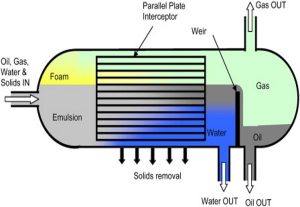
Horizontal Three-Phase Separator With Overflow Weir
In a horizontal three-phase separator with an overflow weir, fluid...
Read More
BTEX Condenser Unit
BTEX Condenser Units are essential components of natural gas dehydration...
Read More