
Read more about the article Scraped Surface Heat Exchangers
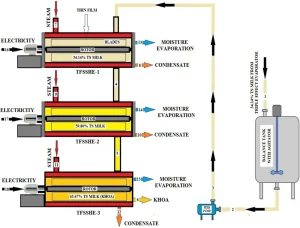
Scraped Surface Heat Exchangers diagram of milk food khoa

Scraped Surface Heat Exchangers

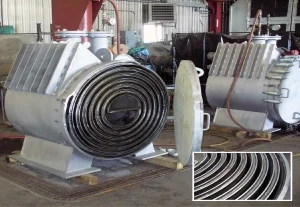
A scraped surface heat exchanger consists of a cylindrical shell with a rotating shaft inside. The shaft is fitted with blades or scrapers that continuously scrape the inner surface of the shell. This scraping action prevents the formation of product buildup on the heat transfer surface, ensuring efficient heat transfer.
Continue ReadingScraped Surface Heat Exchangers
Read more about the article  Steam Heat Exchanger – Indirect Heater
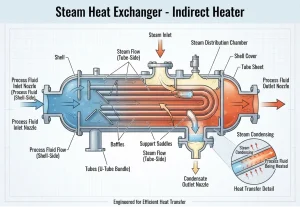
A diagram showing a Steam Heat Exchanger - Indirect Heater

 Steam Heat Exchanger – Indirect Heater

Steam Heat Exchanger - Indirect Heater is used to heat the well effluent after it flows out of the well and prior to the separating process. This type of heat exchanger is also called a direct heating furnace which allows it to heat up the process coil directly. This is a kind of heating furnace that has the maximum heat exchange efficiency among the heating furnaces.

Continue Reading Steam Heat Exchanger – Indirect Heater
Read more about the article Steam Heat Exchanger
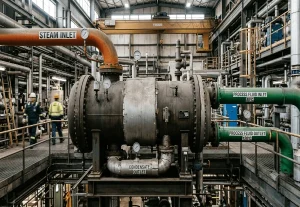
A picture of a Steam Heat Exchanger

Steam Heat Exchanger

Steam-heat exchangers are used to raise the temperature of well effluents to prevent hydrate formation, reduce viscosity, and break down emulsions for efficient separation of oil and water. Because steam-heat exchangers drastically reduce risk, they are used on offshore platforms and in other work conditions where safety regulations do not permit the use of indirect-fired heaters.

Continue ReadingSteam Heat Exchanger
Read more about the article Plate and Frame Heat Exchangers
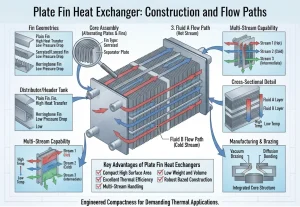
A infographic of a Plate Fin Heat Exchanger

Plate and Frame Heat Exchangers

Plate and frame heat exchangers are a type of heat exchanger that uses a series of corrugated plates to transfer heat between two fluids. The plates are stacked together, forming narrow channels through which the fluids flow. This design allows for a large heat transfer surface area in a compact footprint.

Continue ReadingPlate and Frame Heat Exchangers
Read more about the article Mix Exchangers
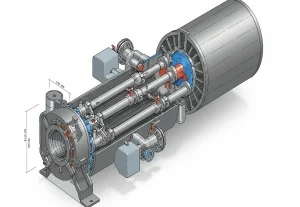
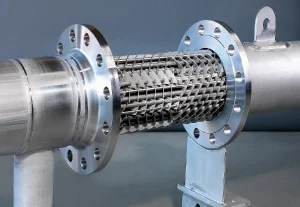
Image shows a static mixer heat exchanger (often referred to generically or commercially as a mix-exchanger or heat exchanger static mixer

Mix Exchangers

Mix exchangers are a type of heat exchanger that combines two or more fluid streams to achieve a desired temperature or composition. They are widely used in various industries, including chemical processing, petroleum refining, and power generation. Mix exchangers play a critical role in many industrial processes. By understanding the key design considerations and selecting the appropriate type of mixer, engineers can optimize the performance of these devices.

Continue ReadingMix Exchangers
Read more about the article Double-Pipe Heat Exchangers
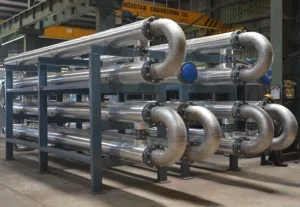
A picture of a Double-Pipe Heat Exchanger

Double-Pipe Heat Exchangers

Double-pipe heat exchangers are a simple yet effective type of heat exchanger that consists of two concentric pipes. One fluid flows through the inner pipe, while the other fluid flows through the annular space between the two pipes. This design provides a compact and efficient solution for many heat transfer applications.

Continue ReadingDouble-Pipe Heat Exchangers
Read more about the article Spiral Heat Exchangers
A picture showing a Spiral Heat Exchanger

Spiral Heat Exchangers

A spiral heat exchanger consists of two spiral-wound channels, one for each fluid. The two channels are separated by a partition, and the fluids flow in opposite directions through the channels. This counter-current flow arrangement maximizes heat transfer efficiency. Spiral heat exchangers are a specialized type of heat exchanger that offer numerous advantages over traditional shell-and-tube and plate-and-frame designs.

Continue ReadingSpiral Heat Exchangers

No more posts to load