
Read more about the article Vertical Three-Phase Separator with A Downcomer and Spreader
Vertical-3-Phase-Separator-with a Downcomer and Spreader

Vertical Three-Phase Separator with A Downcomer and Spreader

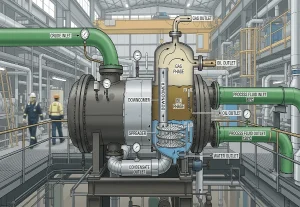
A three-phase separator is a crucial piece of equipment in the oil and gas industry, designed to separate a mixture of oil, gas, and water into its individual components. The vertical three-phase separator, equipped with a downcomer and spreader, is a particularly efficient design for handling a wide range of flow rates and liquid-gas ratios.
Continue ReadingVertical Three-Phase Separator with A Downcomer and Spreader
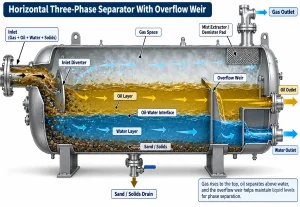
Read more about the article Horizontal Three-Phase Separator With Overflow Weir
A picture showing how a Horizontal Three-Phase Separator With Overflow Weir works

Horizontal Three-Phase Separator With Overflow Weir

In a horizontal three-phase separator with an overflow weir, fluid enters the vessel through an inlet and immediately hits an inlet diverter. The sudden impact and change of direction helps to release the gas by breaking the surface tension of the liquid.

Continue ReadingHorizontal Three-Phase Separator With Overflow Weir
Read more about the article Two-Phase Vertical Separator
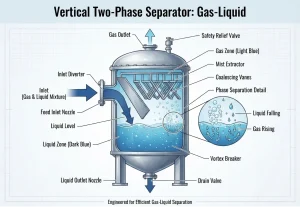
A flow chart of a Two-Phase Vertical Separator

Two-Phase Vertical Separator

A vertical separator is a cylindrical vessel that is oriented vertically. When a gas-liquid mixture enters the separator, the heavier liquid phase settles to the bottom, while the lighter gas phase rises to the top. The liquid phase is then drawn off through a liquid outlet nozzle, while the gas phase exits through a gas outlet nozzle located at the top of the vessel.

Continue ReadingTwo-Phase Vertical Separator
Read more about the article Two-Phase Horizontal Separators
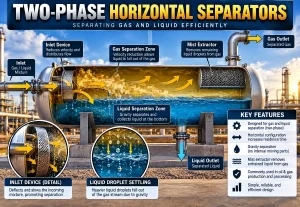
A infographic of a Two-Phase Horizontal Separator

Two-Phase Horizontal Separators

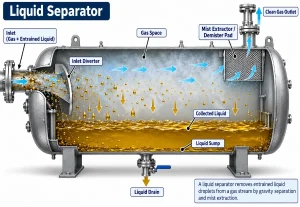
A horizontal separator is a cylindrical vessel that is oriented horizontally. When a gas-liquid mixture enters the separator, the heavier liquid phase settles to the bottom of the vessel, while the lighter gas phase rises to the top. Horizontal separators are a common type of pressure vessel used to separate gas and liquid mixtures.

Continue ReadingTwo-Phase Horizontal Separators
Read more about the article Two-Phase Spherical Separators
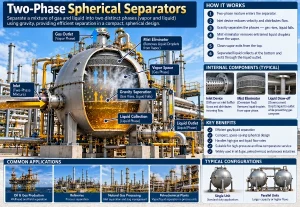
Infographic of Spherical-Separators

Two-Phase Spherical Separators

Two-Phase Spherical Separators operate on the principle of gravity separation. When a gas-liquid mixture enters the vessel, the heavier liquid phase settles to the bottom, while the lighter gas phase rises to the top. The unique spherical shape of the vessel promotes efficient separation by minimizing turbulence and maximizing the contact area between the two phases.

Continue ReadingTwo-Phase Spherical Separators
Read more about the article Two-Phase Separator
A diagram showing a Two-Phase Separator

Two-Phase Separator

Depending on the specific application and the vapor-liquid mixture being separated, two-phase vessels can be oriented vertically or horizontally. In their simplest form, they are an empty tank that are used to reduce the velocity of a fluid on entry, thus allowing the liquid to fall to the bottom of the vessel and the vapor to rise to the top.

Continue ReadingTwo-Phase Separator
Read more about the article Sand Separators
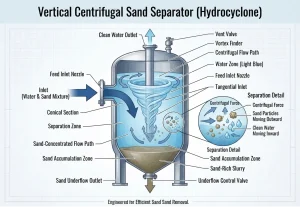
A diagram of a Sand Separator

Sand Separators

Sand Separators. In the oil and gas industry, it is more commonly known as a separator and is a core component of extracting oil from earth and sand. Sand separators are an integral part in protecting downstream production equipment from well-formation sand and/or frac sand. The Sand Separator is a pressure vessel specifically designed

Continue ReadingSand Separators
Read more about the article Vertical Three-Phase Separator with Interface Control
Vertical Three-Phase Separator with Interface Control

Vertical Three-Phase Separator with Interface Control

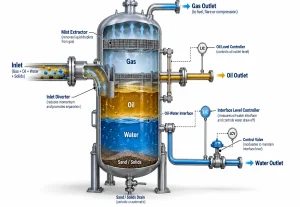
A three-phase separator is a crucial piece of equipment in the oil and gas industry, designed to separate a mixture of oil, gas, and water into its individual components. The vertical three-phase separator, equipped with interface control, is a particularly efficient design for maintaining optimal separation efficiency and preventing liquid carryover.

Continue ReadingVertical Three-Phase Separator with Interface Control
Read more about the article Horizontal Three-Phase Separator with Oil Bucket and Water Weir
Horizontal Three-Phase Separator with Oil Bucket and Water Weir

Horizontal Three-Phase Separator with Oil Bucket and Water Weir

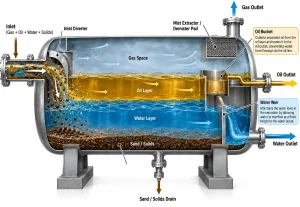
In a horizontal three-phase separator with an oil bucket and water weir, the vessel does not require an active interface controller. As the oil separates on top of the water it spills over the weir plate and into the oil bucket. The oil level in the bucket is controlled by a level controller sending a signal to the oil dump valve.

Continue ReadingHorizontal Three-Phase Separator with Oil Bucket and Water Weir

No more posts to load