


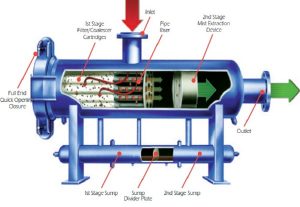
Filter Separators
Filter separators are widely used in various industries to remove solid particles from liquid streams. They are essential for maintaining product quality, protecting downstream equipment, and ensuring efficient processes.
Filter separators are widely used in various industries to remove solid particles from liquid streams. They are essential for maintaining product quality, protecting downstream equipment, and ensuring efficient processes.
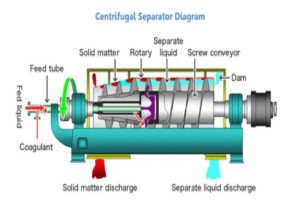
A centrifugal separator typically consists of a rotating bowl or drum. The fluid mixture is introduced into the bowl, and as the bowl spins, the centrifugal force causes the denser particles to move towards the outer wall, while the lighter fluid remains near the center. The separated components can then be continuously or periodically removed.
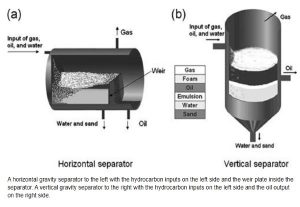
Gravity separators are a fundamental type of separation equipment that leverages the principle of density difference to separate solid particles from liquids or different liquid phases from each other. They are widely used in various industries, including oil and gas, water treatment, and mining.
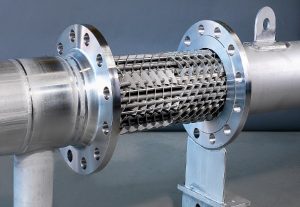
Mix exchangers are a type of heat exchanger that combines two or more fluid streams to achieve a desired temperature or composition. They are widely used in various industries, including chemical processing, petroleum refining, and power generation. Mix exchangers play a critical role in many industrial processes. By understanding the key design considerations and selecting the appropriate type of mixer, engineers can optimize the performance of these devices.
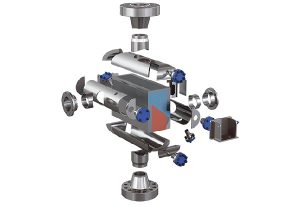
Printed Circuit Heat Exchangers (PCHEs) are a specialized type of heat exchanger that offers exceptional heat transfer performance in a compact footprint. They are widely used in industries such as aerospace, automotive, and electronics. PCHEs consist of a stack of thin metal plates, etched with microchannels that form intricate flow passages.
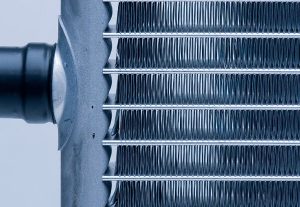
Microchannel heat exchangers are a type of heat exchanger with channels that have characteristic dimensions in the micrometer range. These tiny channels offer significant advantages in terms of heat transfer efficiency and compact design. In a microchannel heat exchanger, the two fluids flow through microchannels etched or machined into metal plates. The large surface area-to-volume ratio and short flow paths enable efficient heat transfer.
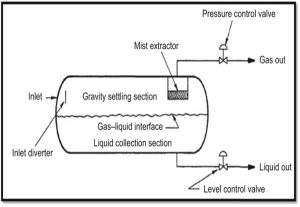
Horizontal separators are ideally suited to wellstreams having high gas-oil ratios, constant flow, and small liquid surge characteristics. Horizontal separators are smaller and less expensive than vertical separators for a given gas capacity. Liquid particles in the wellstream travel horizontally and downward at the same time as a result of two forces acting upon them-the horizontal force of the gas stream and the downward force of gravity.
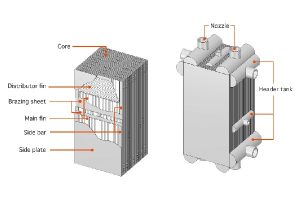
A plate fin heat exchanger consists of a core, which is a stack of corrugated plates, and fins, which are attached to the plates to increase the surface area for heat transfer. One fluid flows through the channels formed by the plates, while the other fluid flows across the fins.
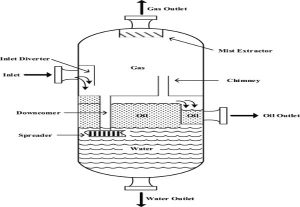
A three-phase separator is a crucial piece of equipment in the oil and gas industry, designed to separate a mixture of oil, gas, and water into its individual components. The vertical three-phase separator, equipped with a downcomer and spreader, is a particularly efficient design for handling a wide range of flow rates and liquid-gas ratios.
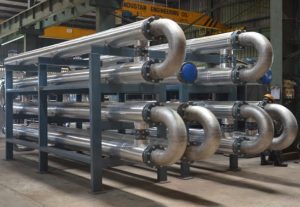
Double-pipe heat exchangers are a simple yet effective type of heat exchanger that consists of two concentric pipes. One fluid flows through the inner pipe, while the other fluid flows through the annular space between the two pipes. This design provides a compact and efficient solution for many heat transfer applications.