
Read more about the article Two-Phase Separator Vs Three-Phase Separator
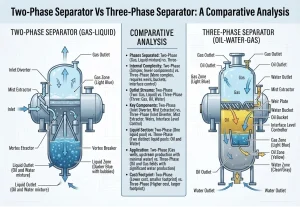
Picture of a Two-Phase Separator Vs Three-Phase Separator

Two-Phase Separator Vs Three-Phase Separator

The key difference between a two-phase separator and a three-phase separator is the number of phases they are designed to separate. While a two-phase separator separates gas and liquid, a three-phase separator can handle gas, oil, and water. The design and internal components of the separators may vary accordingly to accommodate the different phases and their interactions.

Continue ReadingTwo-Phase Separator Vs Three-Phase Separator
Read more about the article Two-Phase Vertical Separator
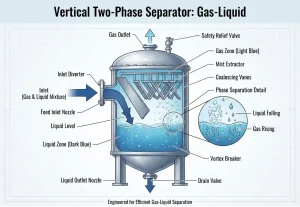
A flow chart of a Two-Phase Vertical Separator

Two-Phase Vertical Separator

A vertical separator is a cylindrical vessel that is oriented vertically. When a gas-liquid mixture enters the separator, the heavier liquid phase settles to the bottom, while the lighter gas phase rises to the top. The liquid phase is then drawn off through a liquid outlet nozzle, while the gas phase exits through a gas outlet nozzle located at the top of the vessel.

Continue ReadingTwo-Phase Vertical Separator
Read more about the article Two-Phase Horizontal Separators
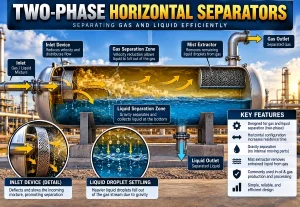
A infographic of a Two-Phase Horizontal Separator

Two-Phase Horizontal Separators

A horizontal separator is a cylindrical vessel that is oriented horizontally. When a gas-liquid mixture enters the separator, the heavier liquid phase settles to the bottom of the vessel, while the lighter gas phase rises to the top. Horizontal separators are a common type of pressure vessel used to separate gas and liquid mixtures.

Continue ReadingTwo-Phase Horizontal Separators
Read more about the article Two-Phase Spherical Separators
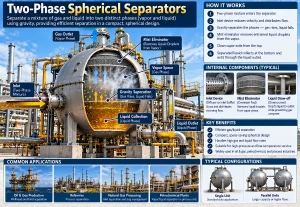
Infographic of Spherical-Separators

Two-Phase Spherical Separators

Two-Phase Spherical Separators operate on the principle of gravity separation. When a gas-liquid mixture enters the vessel, the heavier liquid phase settles to the bottom, while the lighter gas phase rises to the top. The unique spherical shape of the vessel promotes efficient separation by minimizing turbulence and maximizing the contact area between the two phases.

Continue ReadingTwo-Phase Spherical Separators
Read more about the article Two-Phase Separator
A diagram showing a Two-Phase Separator

Two-Phase Separator

Depending on the specific application and the vapor-liquid mixture being separated, two-phase vessels can be oriented vertically or horizontally. In their simplest form, they are an empty tank that are used to reduce the velocity of a fluid on entry, thus allowing the liquid to fall to the bottom of the vessel and the vapor to rise to the top.

Continue ReadingTwo-Phase Separator

No more posts to load